
How to Remove Efflorescence from Tiles, Pavers and Brick
Those white, powdery marks on your balcony tiles, pavers or brick walls are usually efflorescence. They are one of the most common call-outs we get on the Northern Beaches, especially on balconies, pool surrounds and retaining walls after wet weather. The good news is that efflorescence can usually be removed in an afternoon. The catch is that it comes back if you don’t deal with where the water is coming from.
This guide is based on more than 20 years of stone and tile work in Sydney. It covers what efflorescence is, how to tell it apart from other white marks, and the exact process we use with ECCOSAFE Salt and Calcium Remover.
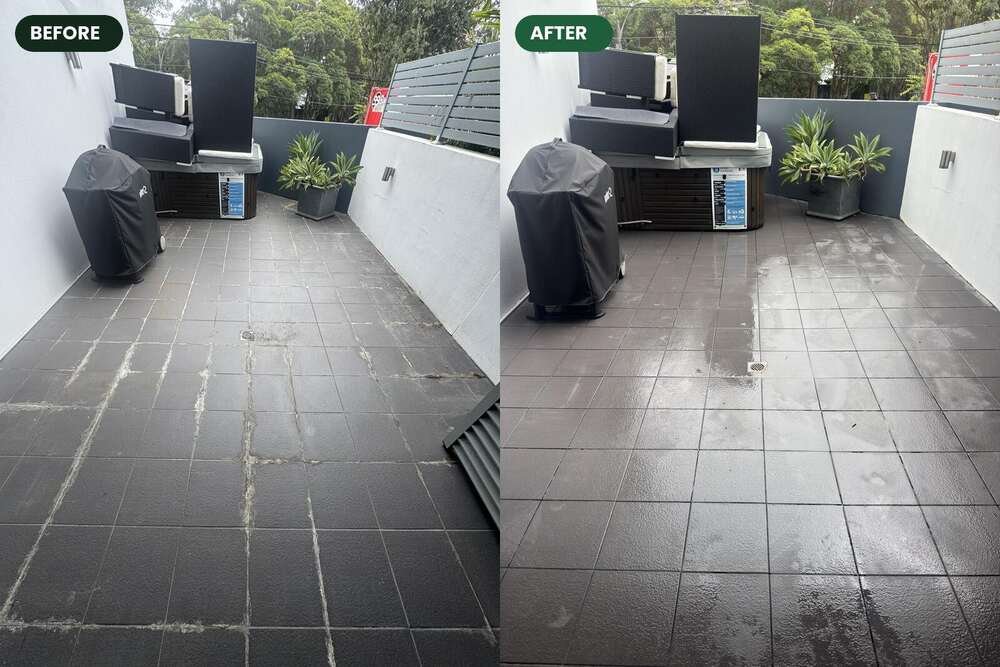
What is efflorescence?
Efflorescence is a deposit of mineral salts left on the surface when water evaporates. Water soaks into concrete, mortar, grout, bedding or brick, dissolves salts that are naturally present in those materials, then travels to the surface. When the water dries, the salts stay behind as a white bloom or crust.
You will typically see it:
- on balconies and patios where water sits or drains slowly
- along grout lines and tile edges
- on new paving and brickwork in the first months after installation
- on retaining walls and planter boxes with soil behind them
- around pools, where splash water keeps the surface wet
How to tell if it is efflorescence
Not every white mark is efflorescence. Before you buy anything, check these three things:
- Wet it. Efflorescence often darkens or seems to disappear when wet, then comes back as the surface dries.
- Rub it. Fresh efflorescence is powdery and brushes off. Older deposits harden into a crust that a brush won’t shift.
- Look at the pattern. It follows grout lines, joints and edges, where water moves. A white film evenly across the tile face is more likely grout haze or a failing coating.
If you are unsure, test a small hidden area first. If the white mark is a coating or sealer breaking down, an acid cleaner won’t fix it.
Which surfaces you can treat
ECCOSAFE Salt and Calcium Remover is an extra heavy duty acidic cleaner. It is suitable for porcelain tiles, brick, concrete and clay pavers, and, with a test first, granite, basalt and sandstone.
Do not use it on acid-sensitive stone: marble, limestone, travertine or terrazzo. Acid will etch these surfaces and the damage is permanent. If you are not sure what your stone is, ask us before you start.
What you need
- ECCOSAFE Salt and Calcium Remover
- ECCOSAFE Neutral Cleaner for the rinse
- a plastic bucket and measuring jug
- a sponge or synthetic mop and a stiff nylon brush
- a wet vac or dense mop to pick up the solution
- rubber gloves and eye protection, plus long sleeves
Step by step: removing efflorescence
- Protect the area. Keep the solution away from carpets, metal fittings, glass balustrade frames and plants. Cover or wet anything nearby.
- Sweep. Remove dirt and loose debris so the cleaner reaches the salts.
- Mix the solution. Concrete: 1 part Salt and Calcium Remover to 20 parts water. Granite, basalt, sandstone and clay pavers: 1 part to 10–15 parts water. Always add the product to the water.
- Test. Try a small, hidden spot first and check the result once it is dry.
- Apply. Spread the solution with a sponge or synthetic mop and leave it for 1 to 2 minutes only.
- Agitate. Scrub gently with a nylon brush. Do not let the solution dry on the surface. Work in small sections.
- Remove. Pick up all the solution with a wet vac or dense mop.
- Rinse twice. Rinse at least twice with Neutral Cleaner diluted 1:10 in water to remove any remaining acidity.
As a guide, 1 litre of Salt and Calcium Remover cleans approximately 20 m².
Safety first
Salt and Calcium Remover is corrosive. It can cause skin burns and serious eye damage. Wear gloves and eye protection, never mix it with other cleaners, and keep children and pets away until the area has been rinsed. Read the label and the Safety Data Sheet before use. Email info@eccosafe.com.au for a copy of the SDS.
Stopping it from coming back
Cleaning removes the salts that are already on the surface. If water keeps moving through the slab, more salts will follow. To reduce repeat efflorescence:
- fix ponding water, blocked drains and poor falls on balconies
- check for leaks from planter boxes, gutters and downpipes
- repair cracked or missing grout
- on porous stone and grout, apply a breathable penetrating sealer such as ECCOSAFE Water Based Seal once the surface is completely clean and dry, to help reduce water absorption
On new paving, some efflorescence in the first few months is normal while the materials dry out. It often needs more than one clean.
Frequently asked questions
Can I use vinegar or a pressure washer instead?
A pressure washer can remove loose, powdery efflorescence, but it adds more water to the surface and won’t shift hardened deposits. Household vinegar is weak and inconsistent, and it is still an acid, so it is not safe on marble or limestone either.
Will it damage my grout?
Acid can attack cement grout if it is too strong or left on too long. Stick to the recommended dilution, keep the dwell time to 1 to 2 minutes, never let it dry, and rinse twice with Neutral Cleaner. Test a small area first.
My balcony is travertine or marble. What can I use?
Do not use an acid cleaner on these stones. Efflorescence on acid-sensitive stone needs a different approach. Contact us at info@eccosafe.com.au with a photo and we will point you in the right direction.